
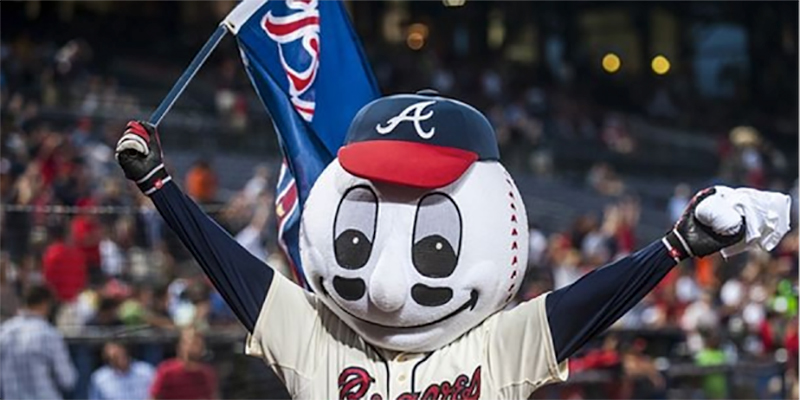
Blooper has been the Atlanta Braves mascot since January 27, 2018. He replaced Homer the Brave, the baseball-headed mascot who had worked Braves games since about 1989 and retired before the 2018 season.
Before Homer came a run of other characters, from the fuzzy red Rally back to Chief Noc-A-Homa in the 1960s. Here’s how the Braves got from one to the next. For every other team, see our MLB mascots list.
Braves mascots at a glance
| Mascot | Years | Appearance and history |
|---|---|---|
| Chief Noc-A-Homa | 1966 to 1985 | A character with a tipi in the stands; Levi Walker Jr. played him from 1969 |
| Bleacher Creature | late 1970s | A shaggy green creature that didn’t last long |
| Rally | from 1986 | A red, fuzzy character with a mohawk |
| Homer the Brave | about 1989 to 2017 | The mascot with a giant baseball for a head |
| Blooper | 2018 to today | A nearly 7-foot fuzzy creature with party horns in his ears |
Homer the Brave
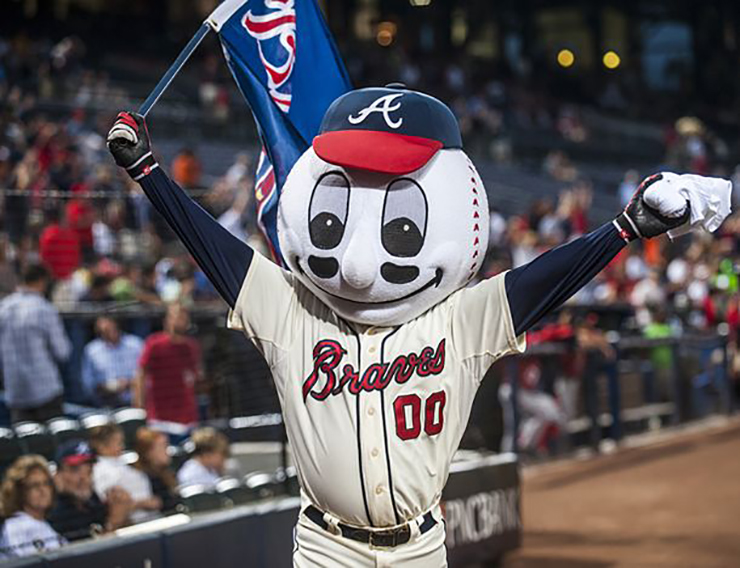
Homer the Brave, the old Braves mascot most fans remember, was the face of Braves game days for close to three decades. His head was a giant baseball, much like that of Mr. Met, the New York Mets mascot.
Homer retired before the 2018 season. The Braves say they created Blooper “with the previous mascot ‘Homer the Brave’ entering retirement.” The sources we checked don’t pin down Homer’s last game, so we list his run as ending in 2017.
Blooper (2018 to today)
The Braves introduced Blooper on January 27, 2018, at Braves Fest at what was then SunTrust Park. The team staged his arrival as a science experiment: a “mad scientist” used a machine called the Character Builder 3000, fed with suggestions from kids, to build the new mascot on stage.
Blooper is nearly 7 feet tall, with beige and brown fur and party horns in his ears, and he wears a 5XL shirt. The first reaction on social media was negative. He won fans over anyway, and by 2020 MLB.com was calling him the season’s breakout mascot superstar.
Today Blooper works every home game at Truist Park and makes community appearances year-round.
Earlier Braves mascots
Rally
Rally, a red, fuzzy character with a mohawk, arrived in 1986, the season after Chief Noc-A-Homa was retired. He faded out years ago, and no source we found pins down his last appearance. He’s no relation to the Angels’ Rally Monkey.
The Bleacher Creature
In the late 1970s, a shaggy green character called the Bleacher Creature roamed Atlanta-Fulton County Stadium. It was short-lived.
Chief Noc-A-Homa and Princess Win-A-Lotta
The Braves’ tipi tradition started in Milwaukee in 1964, when a teenage student set up a tipi in the County Stadium bleachers. After the team moved to Atlanta in 1966, the character became Chief Noc-A-Homa, a name picked in a fan contest and announced on July 26, 1966. Levi Walker Jr., a member of the Odawa nation from Michigan, played the role from 1969 to 1985. Princess Win-A-Lotta joined him in 1983.
The character was retired before the 1986 season. According to reporting at the time, Walker and the team agreed to part ways over disagreements about pay and missed dates.
Braves mascot FAQ
What is the Braves mascot’s name?
Blooper. He has been the Atlanta Braves mascot since January 27, 2018.
Is Homer the Brave still the Braves mascot?
No. Homer retired before the 2018 season, and Blooper replaced him.
Who was the Braves’ first mascot in Atlanta?
Chief Noc-A-Homa, who appeared at Braves games from the team’s first Atlanta season in 1966 until 1985.
What is Blooper supposed to be?
The team’s own description doesn’t name an animal. It calls Blooper big, fuzzy, funny and mischievous, and his backstory says a mad scientist built him on stage at Braves Fest in 2018.
Why was Chief Noc-A-Homa retired?
According to reporting at the time, Levi Walker Jr. and the Braves agreed to part ways before the 1986 season over disagreements about pay and missed dates.
Sources: Atlanta Braves, Meet Blooper; MLB.com, Blooper is 2020’s breakout mascot superstar; The Atlanta Journal-Constitution, Braves have a history of fuzzy mascots; Wikipedia, Chief Noc-A-Homa, which cites The New York Times (1986). How we check facts: About page.